

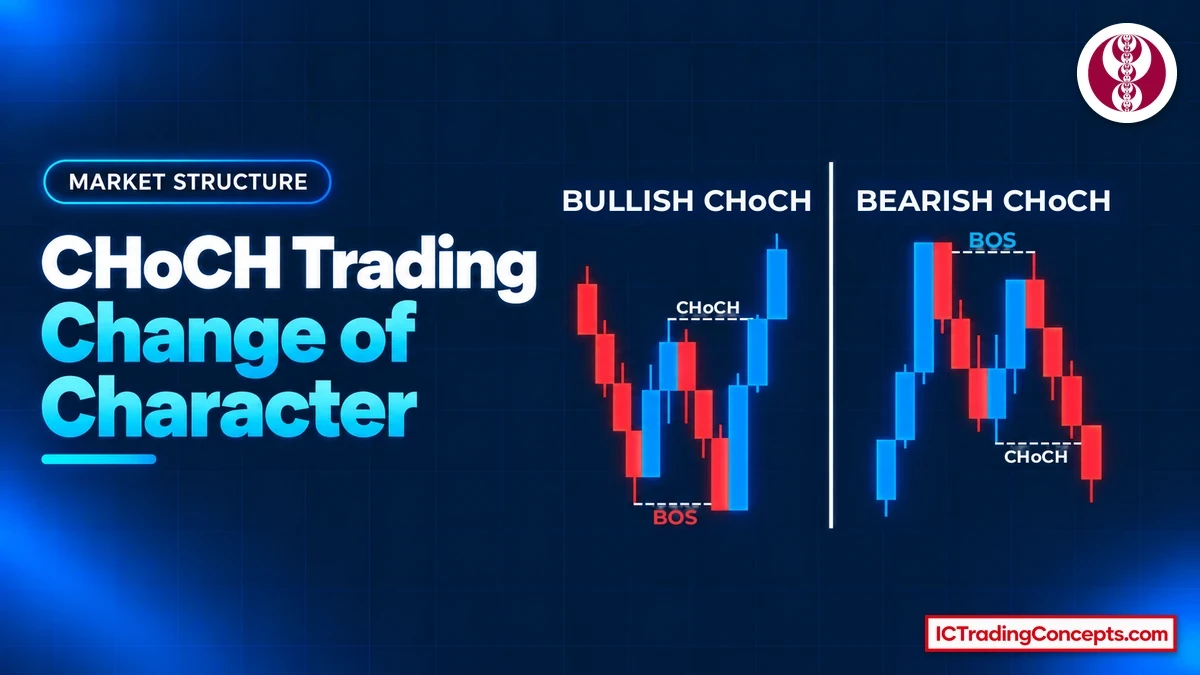
A CHoCH (Change of Character) is the first break of market structure against the current trend. In an uptrend, it happens when price breaks below the most recent higher low. In a downtrend, it happens when price breaks above the most recent lower high. It is an early warning that the trend may be ending, not proof that a new trend has started.
Key Takeaways
- A bearish CHoCH breaks the last higher low of an uptrend. A bullish CHoCH breaks the last lower high of a downtrend.
- A CHoCH signals a possible trend change. A break of structure (BOS) in the new direction is what confirms it.
- A common filter is a candle body close beyond the level, because wicks often poke through and snap back.
- A CHoCH carries more weight when it breaks a major swing with strong displacement at a higher-timeframe level.
- A common approach is to wait for a pullback into the order block or fair value gap left by the break instead of chasing it.
What Is a Change of Character (CHoCH)?
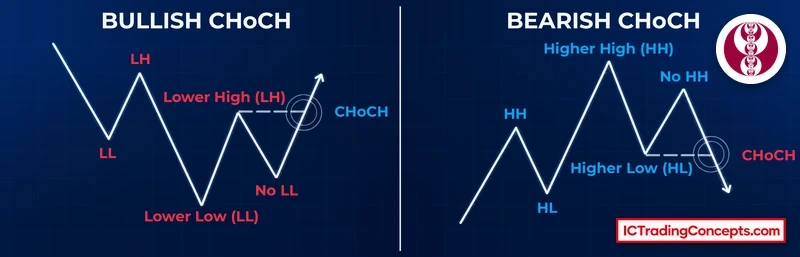
Market structure is the sequence of swing highs and swing lows that price leaves on a chart. In an uptrend, price prints higher highs and higher lows. In a downtrend, it prints lower lows and lower highs. This is the classic swing-based definition of a market trend.
Every trend has one swing that keeps it intact. In an uptrend, it is the most recent higher low, the low that launched the latest higher high. In a downtrend, it is the most recent lower high. Traders often call this the protected swing.
A Change of Character is the moment price breaks that protected swing, so its direction is always the opposite of the trend it interrupts:
- Bearish CHoCH: in an uptrend, price breaks below the most recent higher low.
- Bullish CHoCH: in a downtrend, price breaks above the most recent lower high.
CHoCH is a core term in Smart Money Concepts (SMC) and ICT-style market structure analysis. It does not predict how far price will travel. It tells you that the trend has lost its structure and that the other side of the market is now worth watching.
Why Is It Called a "Change of Character"?
"Character" describes how price has been behaving. In an uptrend, the character is simple: pullbacks hold above the previous higher low, and each rally makes a new high. When price breaks the higher low instead, it is doing something an uptrend does not do. The behavior has changed, so the trend's character has changed.
So the CHoCH meaning is a change in behavior, not a confirmed new trend. That distinction shapes how the signal is used in practice.
How a CHoCH Forms
A CHoCH needs an existing trend to interrupt, so it always builds on top of clear swing structure. It forms in three stages:


- Trend: price makes at least two higher highs and higher lows (or two lower lows and lower highs), so there is a structure to break.
- Failed continuation: the next push loses momentum. Price either fails to make a new extreme or makes one that does not hold.
- Break: price reverses through the protected swing. That break is the CHoCH.
Bullish CHoCH
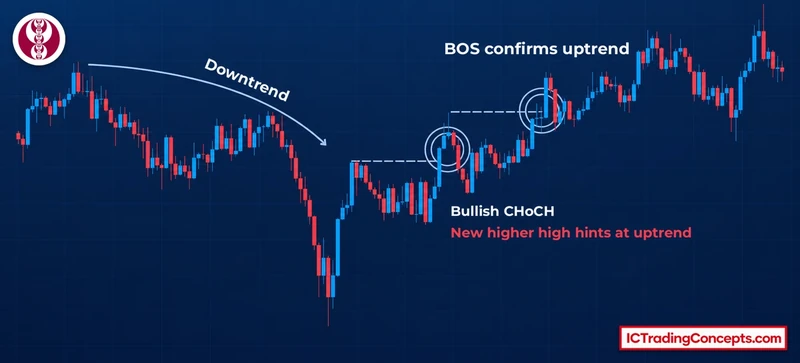
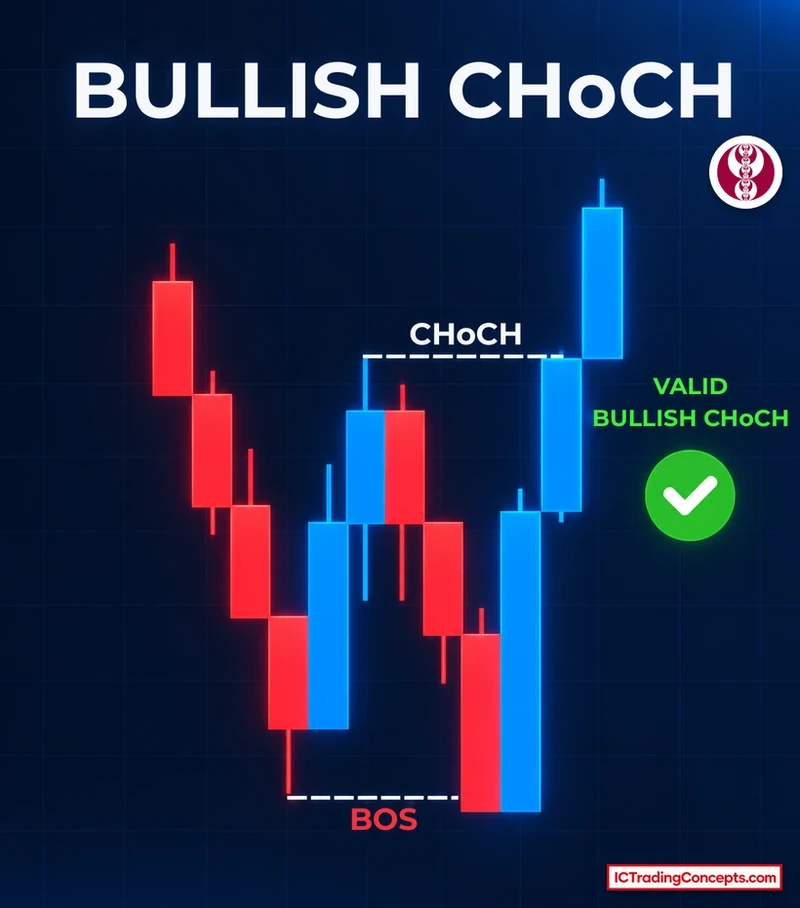
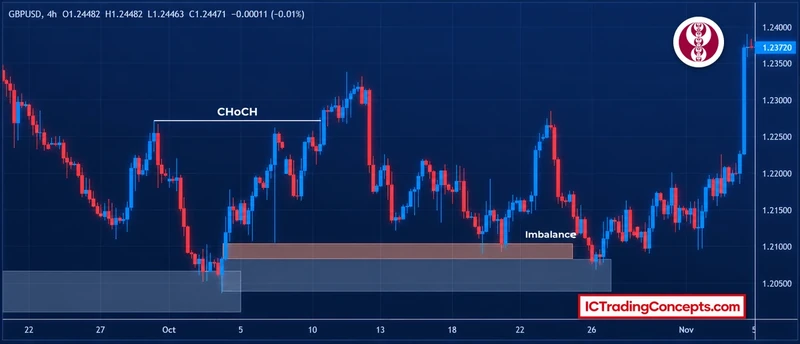
A bullish CHoCH forms at the end of a downtrend. Price has been making lower lows and lower highs, then rallies above the most recent lower high. That is the first higher high after a series of lower highs, and it shows sellers could not defend the level the downtrend depended on.
After a bullish CHoCH, rallies are no longer treated as selling opportunities. The focus shifts to whether the next pullback forms the first higher low of a new uptrend. The change of character example below shows this break, followed by a BOS in the new direction.
Bearish CHoCH
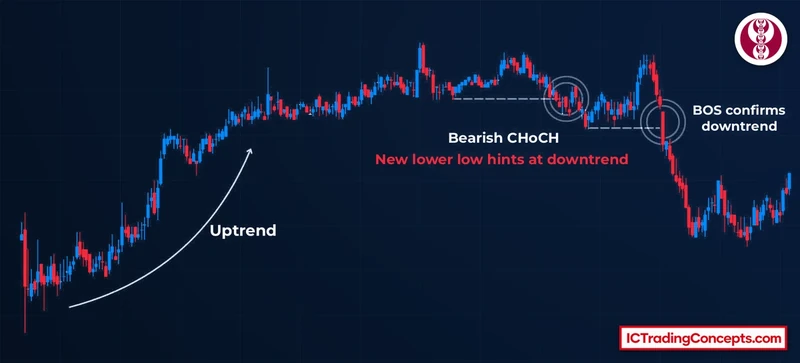
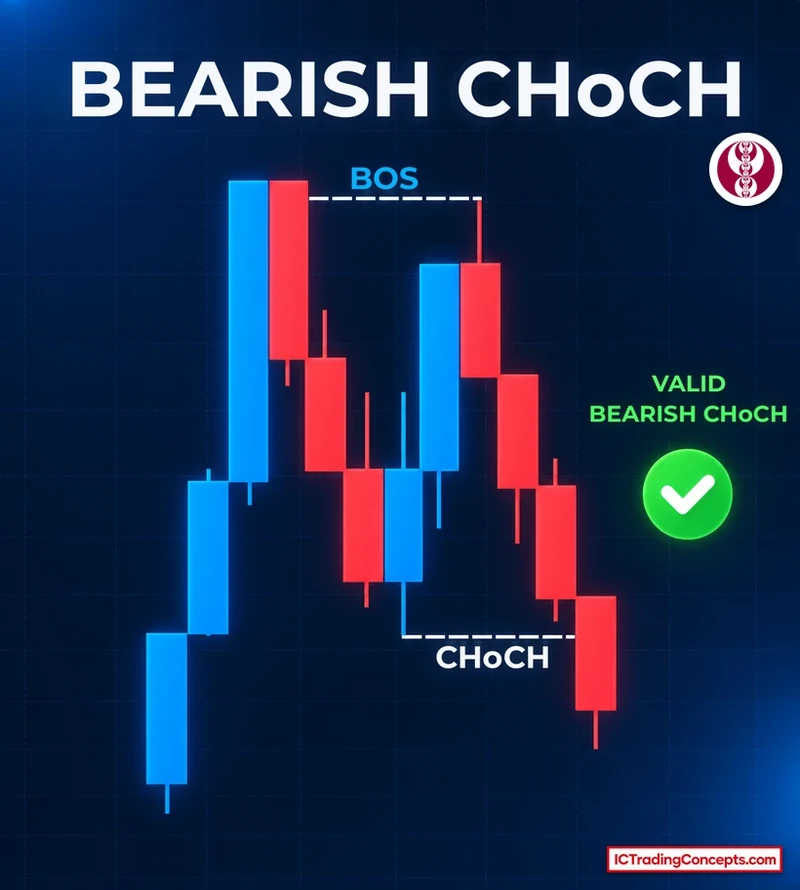
A bearish CHoCH forms at the end of an uptrend. Price has been making higher highs and higher lows, then drops below the most recent higher low. That is the first lower low after a series of higher lows, and it shows buyers could no longer hold the low that supported the uptrend.
After a bearish CHoCH, dips are no longer treated as automatic buying opportunities. The focus shifts to whether the next rally forms a lower high.
How to Identify and Mark a CHoCH Correctly
Many CHoCH errors come from marking the wrong swing rather than from missing the break. Use this process on the timeframe you are analyzing:
- Confirm there is a trend. Look for at least two higher highs and higher lows, or two lower lows and lower highs. Without a trend, there is no character to change.
- Find the protected swing. In an uptrend, take the higher low that produced the latest higher high. In a downtrend, take the lower high that produced the latest lower low. Small pauses inside a leg do not count.
- Mark its extreme. Draw a horizontal line at the low of that higher low (uptrend) or the high of that lower high (downtrend).
- Wait for the break. A common filter is a candle body close beyond the line. A wick that pokes through and closes back inside is not treated as a confirmed break.
- Label the break as a CHoCH and note whether it broke a major swing or a minor one inside a larger leg.
The last step matters because structure exists at two levels. Internal (minor) structure is made of the small swings inside one leg of the trend. Swing (external) structure is made of the larger highs and lows that define the trend itself. An internal CHoCH can be nothing more than a pullback within the bigger move, while a swing CHoCH breaks the level the whole trend relied on.


The same rule applies in reverse for a bearish CHoCH. The line goes at the low of the higher low that created the latest higher high, not at the nearest minor dip inside the last rally.
Why Does a CHoCH Matter?
In a healthy trend, each push breaks structure in the trend's direction and each pullback holds above (or below) the previous swing. A CHoCH means that pattern failed: the expected continuation did not come, and the opposite side was strong enough to take out the level the trend relied on. That is why it is read as a shift in order flow, even before a new trend is visible.
For a trader, that shift has three practical uses:
- Early warning: it flags a possible trend change before a full reversal is obvious on the chart.
- Bias shift: after a CHoCH, entries in the old trend direction become riskier, and setups in the new direction become worth watching.
- Clear invalidation: the swing that produced the CHoCH gives a defined level where the idea is wrong.
The limit is timing. A CHoCH is early by design, so some turn out to be deeper pullbacks inside the original trend. The next section covers how to separate stronger signals from weaker ones.
Strong vs Weak CHoCH: What Makes the Difference
Two CHoCHs can look alike on a chart and still carry very different weight. The difference comes from how price broke the level, which swing it broke and where the break happened:
| Factor | Stronger CHoCH | Weaker CHoCH |
|---|---|---|
| How it breaks | Candle body closes beyond the swing with displacement (large, decisive candles) | Wick through the level, or small overlapping candles |
| Which swing | Swing (major) structure | Internal (minor) swing inside a larger leg |
| Location | At a higher-timeframe level such as an order block or fair value gap | Mid-range, with no higher-timeframe reference |
| What came before | A sweep of an obvious high or low | No liquidity taken before the break |
| What comes after | Price holds beyond the level, and a BOS follows in the new direction | Price quickly reclaims the broken level |
| Market condition | Clear prior trend | Choppy, sideways price action |
None of these factors guarantees a result. They raise or lower the weight you give the signal. Displacement is often the easiest to see: a strong break often leaves a fair value gap behind it, which later becomes a reference for entries.
Liquidity Sweep as Added Context
A liquidity sweep is a quick move beyond an obvious high or low, where stop orders tend to cluster, followed by a reversal. At the end of an uptrend, for example, price may push just above the last high, trigger the buy stops resting there and then fall through the protected higher low.
When a CHoCH follows a sweep like this, the story is clearer: the trend's last push took liquidity and then failed. A liquidity sweep can provide additional context for a CHoCH setup, but it is not part of the definition. A CHoCH without a prior sweep is still a CHoCH.
How to Spot a Fake CHoCH
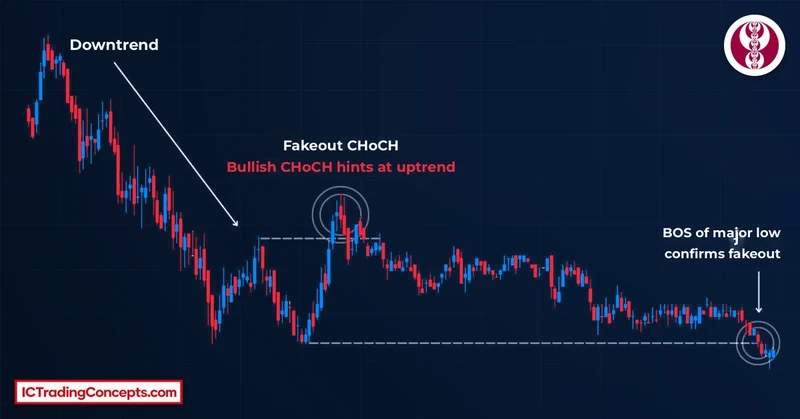
A fake CHoCH breaks the protected swing but fails to follow through, and price returns to the original trend. It often shows one or more of these warning signs:


- The break is a wick, or a small candle that barely closes beyond the level.
- Price reclaims the broken level within a few candles.
- It breaks only an internal swing while the higher-timeframe trend stays intact.
- It forms during a news spike or in quiet, low-participation hours.
When price closes back beyond the broken level and then makes a BOS in the original trend direction, the CHoCH has failed. Treat that reclaim as your invalidation rather than waiting for the reversal to resume.
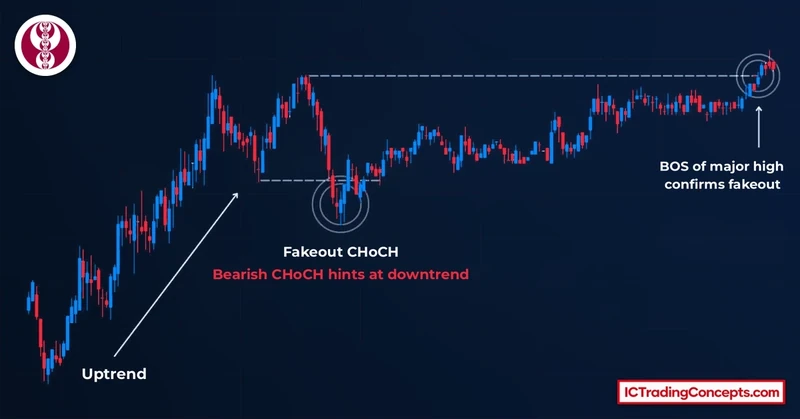
The same trap appears in an uptrend. Price breaks below the last higher low, sellers fail to follow through, and a BOS above the high that started the drop shows the uptrend is still in control.
CHoCH vs BOS and MSS
CHoCH is often confused with two nearby labels. All of them describe breaks of swing points, but they answer different questions about the trend:
| Term | What breaks | What it suggests |
|---|---|---|
| BOS (Break of Structure) | A swing in the trend's direction: a new higher high in an uptrend or a new lower low in a downtrend | The trend is continuing |
| CHoCH (Change of Character) | The protected swing against the trend: the last higher low in an uptrend or the last lower high in a downtrend | The trend may be changing |
| MSS (Market Structure Shift) | A swing point against the trend, broken by a body close with displacement (ICT's term) | A shift in structure; usage overlaps with CHoCH |
CHoCH vs BOS
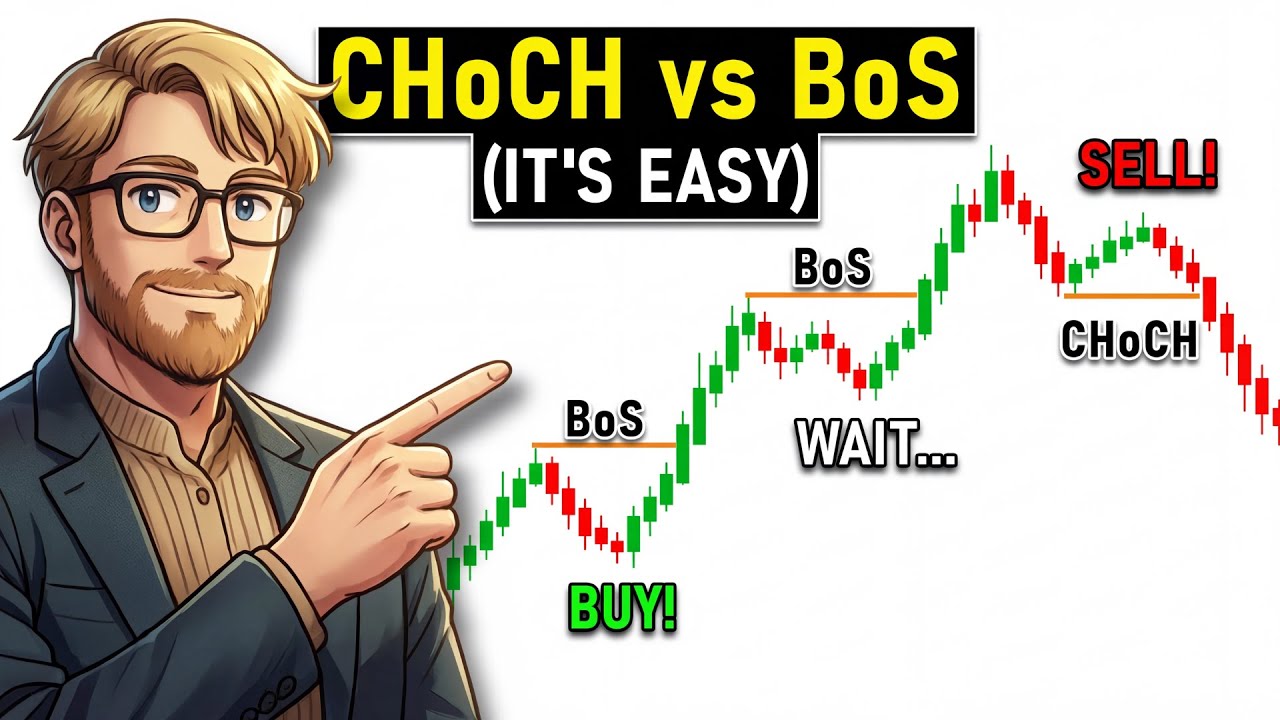
A BOS is a continuation signal: price breaks a swing in the same direction as the trend. A CHoCH is the first break against it. The two often appear in sequence. First, a CHoCH shows that the old trend's structure has broken. Then the first BOS in the new direction shows that price is building a new trend.
Put simply, the CHoCH is the warning and the BOS that follows is the confirmation.
CHoCH vs MSS
Market Structure Shift (MSS) is the ICT term for a break of structure against the trend. Many educators use MSS and CHoCH almost interchangeably. On this site, an MSS also needs displacement, so its closest SMC equivalent is a CHoCH made with clear displacement.
For practical use, the label matters less than the details: which swing was broken, and how decisively.


How CHoCH Is Used in Practice
In practice, a CHoCH is used for bias and timing rather than as a standalone entry trigger. It tells you which side of the market to focus on, and the entry comes later, when price pulls back.
Entries After the Break: Order Blocks and FVGs
The displacement move that breaks the protected swing often leaves two reference zones behind:
- Order block: the last opposite-colored candle (or small group of candles) before the displacement move.
- Fair value gap (FVG): a three-candle imbalance where the wicks of the first and third candles do not overlap.
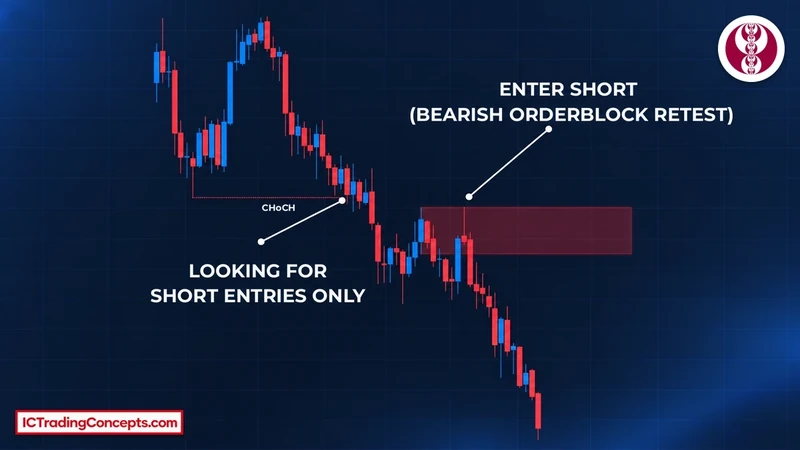
A common approach is to wait for price to pull back into one of these zones rather than entering on the break itself. Waiting keeps the invalidation point closer: the stop can sit beyond the swing high or low that started the CHoCH move, and the target is often the opposite liquidity, such as a previous high or low. If price never returns to the zone, there is no entry. Chasing the break tends to mean a wider stop and a weaker risk-to-reward.
After a bearish CHoCH, the same logic runs in reverse. Price rallies back into the bearish order block or FVG left by the drop, and the stop goes above the swing high that started the move.
Reading the Signal Across Timeframes
A CHoCH can form on any timeframe, but its meaning scales with the timeframe. A CHoCH on the daily or 4-hour chart points to a broader shift, while one on the 5-minute chart may only mark a short-term turn inside a bigger move. Lower timeframes also print more CHoCHs, and more of them fail.


There is no single best timeframe for CHoCH. One common multi-timeframe approach splits the work across three layers:
| Timeframe role | Typical charts | What it is used for |
|---|---|---|
| Higher timeframe | Daily, 4-hour | Trend direction and key zones (order blocks, FVGs, major highs and lows) |
| Setup timeframe | 1-hour, 15-minute | Watching for a CHoCH when price reaches a higher-timeframe zone |
| Entry timeframe | 5-minute, 1-minute | Refining the entry on the pullback after the CHoCH |
The key rule: a lower-timeframe CHoCH against the higher-timeframe trend is often just a pullback. It carries more weight when it forms at a higher-timeframe zone and points in the direction that zone suggests.
Different Markets and Sessions
Because a CHoCH is built from swing highs and lows, the same logic applies to forex, stock indices, futures, gold, crypto and individual stocks. What changes between markets is liquidity and volatility, which affect how clean the swings and breaks look.
Timing matters too. In forex, trading is concentrated in a few centers: in the BIS Triennial Survey of April 2025, sales desks in the United Kingdom and the United States accounted for about 38% and 19% of global FX trading. That concentration helps explain why the London and New York sessions are typically the most active hours for major pairs. A CHoCH that forms while those sessions are active often comes with more participation than one formed in quiet hours, when thin trading makes small breaks easier to reverse.
Common Mistakes to Avoid
Many CHoCH mistakes come from reading the break without its context. These five come up again and again:
- Calling every counter-trend break a CHoCH. Breaking a minor swing or a random support level is not the same as breaking the protected swing. Check which swing actually held the trend.
- Acting on a wick. A wick through the level that closes back inside is not a confirmed break. Wait for the candle to close.
- Ignoring the higher timeframe. A 5-minute CHoCH against a strong daily trend is more likely to be a pullback than a reversal.
- Treating the CHoCH as a confirmed reversal. It is an early warning. Entering on the break itself, before any pullback or BOS, often means a wide stop and a poor risk-to-reward.
- Looking for a CHoCH in a range. In sideways price action there is no clear trend, so there is no character to change. Breaks inside a range flip back and forth and mean little.
Indicators That Mark CHoCH Automatically
An indicator can mark swing points and label BOS and CHoCH for you, which helps with consistency and backtesting. Each tool uses its own fixed swing rules, so its labels will not always match a manual read. Use them to check your marking, not to replace it. Three relevant options on TradingView:
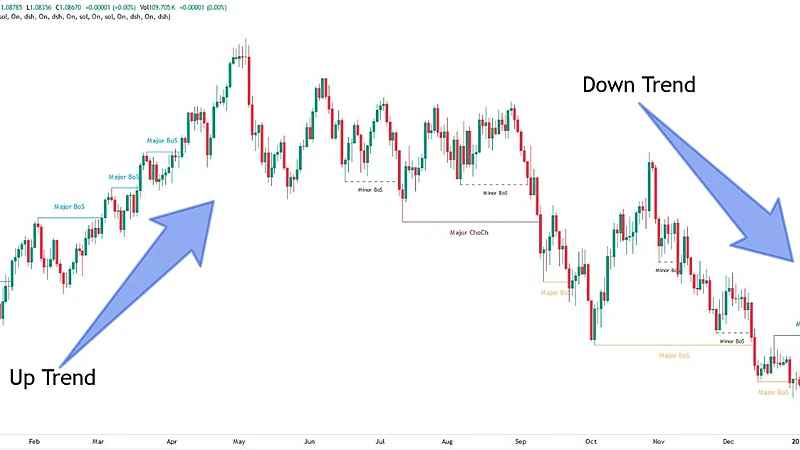
Market Structures SMC (BOS/CHoCH Major & Minor)
Labels CHoCH and BOS on both major and minor structure, so the difference between swing and internal CHoCHs is easy to see.
View on TradingView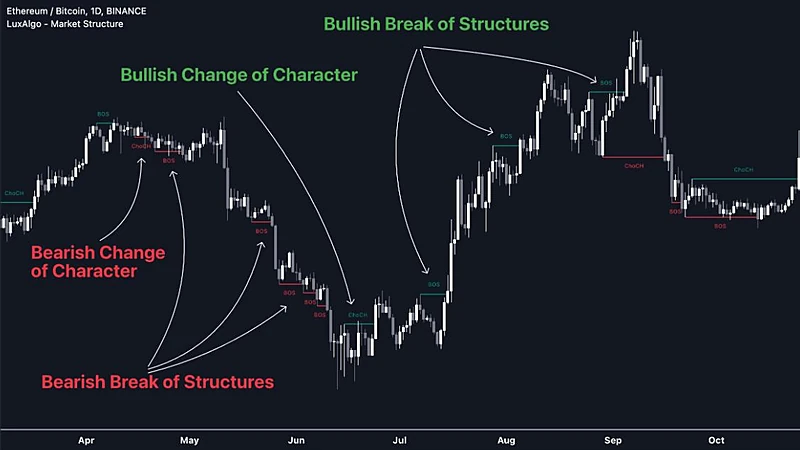
Market Structure CHoCH/BOS (Fractal)
Detects CHoCH and BOS from fractal swing points and shows the related support and resistance levels.
View on TradingView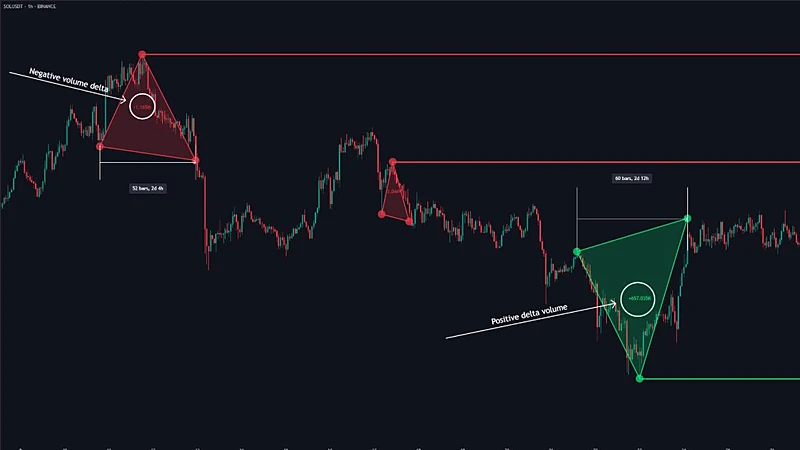
CHoCH Pattern Levels
Plots the levels where CHoCH breaks occur and keeps them on the chart as potential reaction zones.
View on TradingViewTest Your CHoCH Trading Knowledge
Eight quick questions on the protected swing, the body close, strong and fake CHoCHs, BOS confirmation and entries. Each answer links back to the section that explains it.
ABCD Answer with your keyboard
-
01In an uptrend, which break is a bearish CHoCH?
A bearish CHoCH breaks the protected swing of an uptrend: the most recent higher low, the one that launched the latest higher high. A new higher high is a BOS, and minor dips inside a leg do not count. Review: What Is a Change of Character (CHoCH)?
-
02In a downtrend, where do you draw the CHoCH line?
Mark the protected swing: the lower high that produced the latest lower low, with the line at its high. A bullish CHoCH is the break above that line. Review: How to Identify and Mark a CHoCH Correctly
-
03Price wicks through the protected swing and closes back inside. How is it treated?
Wicks often poke through and snap back. A common filter is a candle body close beyond the line, so a wick that closes back inside is not treated as a confirmed break. Review: Common Mistakes to Avoid
-
04What confirms the trend change after a CHoCH?
A CHoCH is the early warning that the old structure has broken. The first BOS in the new direction is what confirms that price is building a new trend. Review: this section
-
05Which detail makes a CHoCH stronger?
A strong CHoCH breaks swing structure with large, decisive candles at a higher-timeframe level such as an order block or FVG. Internal breaks, ranges and quick reclaims point to a weaker signal. Review: Strong vs Weak CHoCH: What Makes the Difference
-
06After a bearish CHoCH, price closes back above the broken level and then makes a BOS in the original uptrend direction. What does this mean?
When price reclaims the broken level and prints a BOS in the original trend direction, the CHoCH has failed. Treat that reclaim as your invalidation instead of waiting for the reversal to resume. Review: this section
-
07What is a common way to enter after a CHoCH?
The displacement that breaks the protected swing often leaves an order block or an FVG. Waiting for a pullback into it keeps the stop closer, beyond the swing that started the move; chasing the break means a wider stop. Review: this section
-
08A 5-minute CHoCH forms against a strong daily trend. How is it best read?
Lower timeframes print more CHoCHs, and more of them fail. A lower-timeframe CHoCH against the higher-timeframe trend is often just a pullback; it carries more weight at a higher-timeframe zone and in that zone's direction. Review: this section
Review your answers
Conclusion
A CHoCH is the first break of the swing that holds a trend together: the last higher low in an uptrend or the last lower high in a downtrend. It warns that the trend may be ending, and it gives a clear level where that view is wrong.
Its value depends on the details. Mark the protected swing, not the nearest minor one. Look for a body close, displacement and a higher-timeframe reason for the break. Then let price confirm with a pullback and a BOS in the new direction before treating the reversal as real.
Sources
- 2022 ICT Mentorship, Episode 2: ICT, YouTube
- OTC foreign exchange turnover in April 2025, Triennial Central Bank Survey: Bank for International Settlements
- Market trend: Wikipedia
Be the first to share your thoughts on this article.